Principal hosts of adults are
cattle and sheep. These ticks also parasitize other domestic and wild mammals.
High intensity of infestation on the baboon Papio ursinus was reported.
Immature ticks feed on hares and rodents.
Literature: Walker et al. (2000).
24. Rhipicephalus glabroscutatum Du Toit, 1941

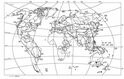
Map 40 Republic of South Africa.
Two-host species. Principal hosts
of all stages are sheep, goats, and the antelope Tragelaphus strepsiceros,
but ticks are also found on other ungulates as well. Immature ticks also
successfully feed on hares. All stages attach to the lower parts of legs and
between the hooves of their hosts. Adults are active from September to February,
and immature ticks are active from March to August. Life cycle takes one year.
Literature: Walker et al. (2000).
25. Rhipicephalus guilhoni Morel and Vassiliades, 1962

Map 19 Mauritania, Senegal, Mali,
Burkina Faso, Niger, Nigeria, Chad, Cameroon (northern), Sudan, and Ethiopia.
Dry savannas.
Principal hosts of adults are
cattle and sheep. Ticks also parasitize other domestic and wild mammals, as
well as large birds, including ostriches, bustards, marabous, and griffins.
Immature ticks feed on hares and rodents. Adults are most numerous during the
rainy season from May to June, and ticks are rarely found on hosts in winter.
Literature: Walker et al. (2000).
26. Rhipicephalus haemaphysaloides Supino, 1897

Map 40 Afghanistan, Pakistan, India,
Nepal, Sri Lanka, Laos, Myanmar, Thailand, Cambodia, Vietnam, Malaysia,
Indonesia (northern Sumatra and Sulawesi), and China.
Adults parasitize various large
and middle-sized mammals, both wild and domestic. Immature ticks feed on small
mammals, including rodents and insectivores.
This species is most abundant in
India, where it is a serious pest to animal husbandry. It is common in Myanmar,
China, and Vietnam, but not numerous on the Malacca Peninsula. In Sri Lanka, R.
haemaphysaloides was found in town, where it parasitized domestic dogs
(unpublished data). It is a vector of buffalo babesiosis.
Literature: Kolonin (1995b), Teng
and Jiang (1991), Petney and Keirans (1996a), Walker et al. (2000).
27. Rhipicephalus hoogstraali Kolonin sp. n.

Map 25 This species is only known from Djibouti and Somalia.
Adults were collected from a sheep, a goat, a camel, and cattle.
Immature ticks have not been described.
Hoogstraal (1953, 1956) was
apparently the first to have recognized this species, providing a description
and figures of a male and a female. However, he misidentified it as Rhipicephalus
longicoxatus Neumann, 1904, which had previously been known only from
Neumann’s original description accompanied by no figures. More recently, the
holotype of R. longicoxatus has been found (Walker et al., 2000),
showing the material identified by Hoogstraal as R. longicoxatus
belonged in fact to another species. Walker et al. (2000) revised some of the
specimens misidentified by Hoogstraal as R. longicoxatus, but considered
them as representing aberrant forms of R. lunulatus.
We have two male and two female Rhipicephalus
collected by V. Popov during April to June of 1973 from cattle in southern
Somalia (Kismajo). Males completely match the features of the species as
described by Hoogstraal as R. longicoxatus. Undoubtedly, it is a valid
species that clearly differs from R. lunulatus. We describe these ticks
as a new species here and name it in honor of Harry Hoogstraal.
The principal differences between
the new species from the closely related R. lunulatus include the
following (figure). In addition to having distinctive adanal shields in the
male, the male and female of R. hoogstraali show longer palpi, and the
base of their capituli is narrower than that in R. lunulatus. The base
of the capituli in male R. hoogstraali is rectangular, whereas in R.
lunulatus it is hexagonal. Male and female R. lunulatus display
large auriculae, whereas the male of R. hoogstraali lacks auriculae
while the auriculae of female R. hoogstraali are very small. The
posteromedian groove on the male scutum of R. hoogstraali is absent,
versus present in male R. lunulatus. Punctation of the female scutum in R.
hoogstraali is sparse, with large punctures, whereas in R. lunulatus
it is denser and diverse, including interspersed fine punctation. The
description by Hoogstraal (1956) of the female of R. longicoxatus, and
the figures illustrating it, resemble R. lunulatus more closely than
they do R. hoogstraali.
Holotype (male) and paratype
(female) have been deposited in the Zoological Museum of Moscow University.
Literature: Hoogstraal (1953,
1956), Walker et al. (2000).

R. hoogstraaliFigure. Rhipicephalus hoogstraali sp. n.
Male: capitulum, dorsal view (1), capitulum, ventral view (2), adanal
shield (3).
Female: capitulum, dorsal view (4), capitulum, ventral view (5).
28. Rhipicephalus humeralis Rondelli, 1926

Map 14 Somalia, Kenya, and Tanzania.
Not numerous species. Adults were
usually collected on cattle, camels, elephants, and rhinoceroses. Adults were
occasionally taken from other domestic and wild mammals as well, but not quite
as often. Immature ticks are described but their hosts in nature are unknown.
Literature: Walker et al. (2000).
29. Rhipicephalus hurti Wilson, 1954

Map 33 Uganda, Rwanda, Burundi, Kenya,
and Tanzania.
Mountain forests and meadows
above the altitude of 1500 m (it frequently occurs together with R. jeanneli).
Principal hosts of adults are
wild buffalo and cattle, but ticks are occasionally found on other ungulates
and carnivores as well. Natural hosts of immature ticks are unknown.
Literature: Walker et al. (2000).
30. Rhipicephalus interventus Walker, Pegram and Keirans, 1995

Map 25 Uganda, Rwanda, Tanzania, Zambia,
and Malawi.
Most collections were taken from
cattle, but single individuals on small and middle-sized antelopes, sheep, and
dogs were also reported. Immature ticks have not been described.
Literature: Walker et al. (2000).
31. Rhipicephalus jeanneli Neumann, 1913

Map 42 Sudan (southern), Uganda, Kenya,
Tanzania, Rwanda, Burundi, and Zaire (eastern).
Mountain forests and meadows
above the altitude of 1500 m (it frequently occurs together with R. hurti).
Principal hosts of adults are
wild buffalo and cattle, but ticks can also be found on wild pigs. Immature
ticks are found on rodents.
Literatures: Walker et al.
(2000).
32. Rhipicephalus kochi Donitz, 1905

Map 57 Kenya (southeastern), Tanzania,
Zambia, Zaire (southeastern), Malawi, Mozambique, Zimbabwe, and the Republic of
South Africa (northeastern).
Adults have a wide range of
hosts, but prefer cattle, wild pigs, buffalo, large antelopes, and hares.
Immature ticks feed on the same species of hosts.
Literature: Walker et al. (2000).
33. Rhipicephalus leporis Pomerantzev, 1946

Map 62 Kazakhstan, Uzbekistan,
Tajikistan, Turkmenistan, Afghanistan, and Iraq(?).
Inhabitant of deserts.
Principal host of all stages is
the hare Lepus tolai, but ticks were also collected on hedgehogs, wolf,
fox, jackal, and other carnivores. Adults parasitize hosts from March to
September with maximum activity recorded in May to June.
Literature: Filippova (1997),
Shamsuddin and Mohammad (1988).
34. Rhipicephalus longiceps Warburton, 1912

Map 34 Namibia and Angola.
Rare species. A few collections
of adults were taken from warthog, giraffe, antelopes, cattle, and domestic
pigs. Immature ticks have not been described.
Literature: Walker et al. (2000).
35. Rhipicephalus longicoxatus Neumann, 1904
Rhipicephalus
camelopardalis Walker and Wiley, 1959

Map 34 Kenya and Tanzania.
Rare species. Nine collections
were taken from giraffes and one from a domestic dog. Larvae have been
described, but hosts of immature ticks under natural conditions are unknown.
Note: Figures and descriptions
of male R. longicoxatus in Hoogstraal (1953, 1956) in fact refer to the
species R. hoogstraali Kolonin sp. n.
Literature: Walker et al. (2000).
36.Rhipicephalus longus Neumann, 1907

Map 25 Cameroon, Central African
Republic, Gabon, Congo, Uganda, Ethiopia, Kenya, Rwanda, Burundi, Tanzania,
Zaire, Angola (north), Zambia, Malawi, and Mozambique (northern).
Adults mainly parasitize
buffaloes and cattle, but occasionally occur on domestic and wild pigs and
dogs. Immature ticks were found on rodents.
Literature: Walker et al. (2000).
37.Rhipicephalus lounsbury Walker, 1990

Map 25 Republic of South Africa.