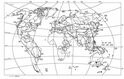
8. Rhipicephalus bursa Canestrini and Fanzago, 1877

Map 41Africa: Morocco, Algeria, Tunisia, and Libya; Europe: Portugal, Spain,
France, Italy, former Yugoslavia, Albania, Switzerland, Greece, Bulgaria,
Romania (southern), Ukraine (southern), and the islands: Madeira, Corsica,
Sardinia, Sicily, and Cyprus; Russia (North Caucasus and Lower Volga region);
Asia: Turkey, Syria, Israel, Iraq (northern), Iran (northern), Georgia,
Armenia, Azerbaijan, Turkmenistan, Uzbekistan, and China (Xingjiang).
Two-host species. All stages
parasitize livestock, preferring sheep and goats. Ticks seldom infest wild
mammals or humans. In the northern parts of their range, adults feed on hosts
from April to September with maximum activity in May to July. Larvae begin to
parasitize in September and molt on the host. Nymphs are located on the hosts
until the end of November. In southern regions, nymphs parasitize during the
entire cold season. Life cycle takes one year.
The species is common and in some
countries (Turkey and Bulgaria) it is abundant. As a vector of many diseases to
livestock, it is a serious pest to animal husbandry.
Literature: Kolonin (1992b),
Filippova (1997), Teng and Jiang (1991), Beesley and Gabai (1991), Walker et
al. (2003).
9. Rhipicephalus camicasi Morel, Mouchet and Rodhain, 1976

Map 13 Africa: Egypt, Sudan, Ethiopia,
Djibouti, Somalia, and Kenya; Asia: Yemen, Saudi Arabia, Lebanon, and Jordan.
Adults were collected from
livestock and a wide variety of wild mammals, from hare to zebra. Immature
ticks have been described, but their hosts in nature are unknown. Adults are
active in the dry season.
Literature: Walker et al. (2000).
10. Rhipicephalus capensis Koch, 1844

Map 14 Republic of South Africa (Cape
Province).
Most adults were collected from
the eland, oryx, cattle, horses, bontebuck, mountain zebra, and fox. Immature
ticks apparently parasitize rodents.
Literature: Walker et al. (2000).
11. Rhipicephalus carnivoralis Walker, 1966

Map 19 Uganda, Kenya, Tanzania, Zambia,
and Nigeria.
Almost all collections were taken
from carnivores, such as lion, leopard, hyenas, and cheetah. Accidental hosts
include cattle, domestic dogs, and humans. Nymphs were found on hyraxes.
Literature: Walker et al. (2000).
12. Rhipicephalus complanatus Neumann, 1911

Map 40 Guinea (southern), Liberia, Cote
d’Ivore, Ghana, Cameroon, Central African Republic, Zaire, Gabon, Congo, and
Angola (northern).
Moist equatorial forests.
Adults almost exclusively
parasitize wild pigs, but ticks occasionally occur on buffalo, bushbuck, and
domestic pigs. Immature ticks have not been described.
Literature: Walker et al. (2000),
Ntiamoa-Baidu et al. (2004).
13. Rhipicephalus compositus Neumann, 1897

Map 9 Sudan (southern), Uganda, Kenya,
Tanzania, Zaire, Rwanda, Burundi, Zambia, Angola, Zimbabwe, and Malawi.
Principal hosts of adults are
wild buffalo and cattle. At the same time, in the northern parts of their range
(Kenya, Uganda, and Sudan), these ticks are rarely found on cattle, but in
Tanzania, Zambia, and Zimbabwe this species is a common parasite of cattle.
Ticks are also found on other ungulates and carnivores, including dogs.
Immature ticks feed on rodents. Adults are active during the end of the dry
season, and their life cycle takes one year.
Literature: Walker et al. (2000).
14. Rhipicephalus cuspidatus Neumann, 1908

Map 41 West Africa from Senegal and
Mauritania to the east as far as Sudan.
Dry savannas. Species inhabit
burrows of the aardvark Orycteropus afer. Life cycle is three-host, and
all stages feed on the same species of hosts. Principal hosts of these ticks
are the aardvark and the warthog Phacochoerus aethiopicus, but ticks
also parasitize other mammals visiting aardvark burrows.
Literature: Walker et al. (2000),
Ntiamoa-Baidu et al. (2004).
15. Rhipicephalus deltoideus Neumann, 1910

Map 41 Lesotho.
Species is only known from the
type collection (one male and three females) taken from an unknown host at the
altitude of 2135 m.
Literature: Walker et al. (2000).
16. Rhipicephalus distinctus Bedford, 1932

Map 52 Sudan (southern), Uganda, Kenya,
Tanzania, Angola, Zimbabwe, Namibia, Botswana, Mozambique, and the Republic of
South Africa.
All stages parasitize various
species of hyraxes. Immature ticks were also found on rabbits, rodents, and
elephant shrews. In the Republic of South Africa, larvae are active from
December to May, nymphs are active from December to March, and imagines are
active from August to January. Life cycle takes one year.
Literature: Walker et al. (2000).
17. Rhipicephalus duttoni Neumann, 1907

Map 41 Angola, Zaire (extreme western),
and Namibia (extreme northwestern).
Principal hosts of all stages are
cattle, but ticks often infest wild buffalo as well. Ticks are found on other
domestic and wild mammals considerably less often. Ticks attach to the ears of
their hosts.
Literature: Walker et al. (2000).
18. Rhipicephalus dux Donitz, 1910

Map 56 Zaire, Uganda (western), Rwanda,
and Angola.
Humid equatorial forests.
Adults were mainly collected on
buffaloes. There are collections from various species of wild pigs, elephant,
cattle, and domestic pigs. Immature ticks have not been described.
Literature: Walker et al. (2000).
19. Rhipicephalus evertsi Neumann, 1897

Map 40 Tropical Africa south of the 18th
latitude, Yemen, and Saudi Arabia (southwestern).
Two-host species. All stages
parasitize both wild and domestic ungulates, preferring perissodactyls, such as
zebras, horses, donkeys, and mules. Immature ticks also successfully feed on
hares, but less often on rodents or birds. In West Africa, ticks only
parasitize domestic livestock and are almost never found on wild ungulates.
Adults attach to the base of tail
and peri-anal area, but immature ticks attach to the ears of their hosts. Ticks
are active all year round. Tick bites can cause paralysis in animals.
Species is divided into two
subspecies. R. evertsi mimeticus Donitz, 1910 occurs in the driest parts
of the range, including Namibia, western Botswana, Angola, south-western Zaire,
and they have been introduced to the Republic of South Africa. R. evertsi
evertsi Neumann, 1897 occupy the rest of the range. In Botswana, ranges of
these subspecies overlap.
Literature: Walker et al. (2000).
20. Rhipicephalus exophthalmos Keirans and Walker, 1993

Map 56 Namibia, Botswana, Republic of
South Africa, and Angola (?).
Principal hosts of adults are
cattle, sheep, goats, antelopes, and hares.
Immature ticks were found on hares and elephant shrews.
Literature: Walker et al. (2000).
21. Rhipicephalus follis Donitz, 1910

Map 6 Republic of South Africa and
Swaziland.
Adults mainly parasitize cattle,
eland, horses, zebras, sheep, and various antelopes. Immature ticks feed on
rodents. Adults are most numerous from August to March.
Literature: Walker et al. (2000).
22. Rhipicephalus fulvus Neumann, 1913

Map 60 Tunisia, Niger, and Chad.
Adults parasitize domestic
livestock, such as sheep, goats, and camels, as well as wild barbary sheep Ammotragus
lervia. Ticks were also found on gundis (Rodentia). Immature ticks were
collected from the gundis Ctenodactylus gundi and Massoutiera mzabi.
Literature: Walker et al. (2000).
23. Rhipicephalus gertrudae Feldman-Muhsam, 1960

Map 33 Namibia and the Republic of South
Africa.